Index
Cheaper Alternative to WATI for Ecommerce Brands in 2026
The full set of essays and reference pages, in the order they are best read.
Your WATI bill keeps climbing while your WhatsApp cart recovery rate stays flat. That gap is why so many ecommerce teams start comparing platforms once message volume grows and per-agent costs stop matching the revenue those conversations bring in.
This article breaks down what actually drives cost in 2026, including pricing models, hidden charges, and the ecommerce features that matter. You will get eight alternatives ranked, from Com.bot at number one through DoubleTick, plus clear criteria for picking the one that fits your store.
What to Look For in a Cheaper WATI Alternative for Ecommerce in 2026
In 2026, ecommerce brands face a crowded market of WhatsApp Business API providers, but the cheapest upfront price often masks costs that balloon as you scale. WATI, one of the better-known names in the space, is frequently criticized for its per-message fees and for ecommerce features that feel bolted on rather than built in.
That combination matters most for high-volume stores. A D2C brand sending order confirmations, shipping updates, and abandoned cart reminders to thousands of buyers each month can watch a modest subscription quietly turn into a significant line item.
A genuine WATI alternative for ecommerce has to balance three things at once: cost, functionality, and scalability. A tool that is cheap at 500 conversations but punishing at 50,000 is not really affordable. It is just deferred expense.
Use the criteria below as a scorecard. The goal is not to find the lowest sticker price, but the lowest total cost of ownership once your WhatsApp channel is doing real work for the business.
Pricing Models, Hidden Costs, and Ecommerce-Specific Features
When comparing WhatsApp API providers, look beyond the monthly subscription: per-message fees, add-on charges, and ecommerce integrations can dramatically alter your total cost of ownership. Three pricing models dominate the market, and each behaves differently as volume grows.
Subscription pricing charges a flat monthly fee, which is predictable but often tiered by seats, contacts, or message allowances. Per-message pricing looks cheap at low volume and becomes the most expensive option for stores that message every customer. Hybrid models blend a base fee with usage charges, so the effective rate depends entirely on your sending patterns.
Hidden costs deserve equal scrutiny. Ask specifically about:
- Setup or onboarding fees charged before you send a single message
- Charges for additional team members or agent seats
- Fees for external actions, such as API calls or automation steps
- Overage charges when you exceed your plan's message or contact limit
- Costs tied to template messages versus session messages
- Markups on top of WhatsApp's own conversation-based rates
Then evaluate ecommerce features. A platform built for conversational commerce should offer native Shopify WhatsApp integration and WooCommerce chat automation without middleware. Look for abandoned cart recovery, COD verification, order confirmation, and shipping updates as first-class flows, not custom builds.
Practical checklist for evaluation:
- Model your real monthly message volume, not a trial-month figure
- Request a full price breakdown including every add-on
- Confirm which ecommerce integrations are native versus custom
- Check whether a chatbot builder and no-code automation are included
- Verify how broadcast messaging is priced and rate-limited
- Ask how costs change if your order volume doubles
Run each candidate through that list. The provider that survives is usually the one whose pricing stays understandable as your store grows, which is the real test of an affordable WhatsApp API for ecommerce.
1. Com.bot - Best Overall
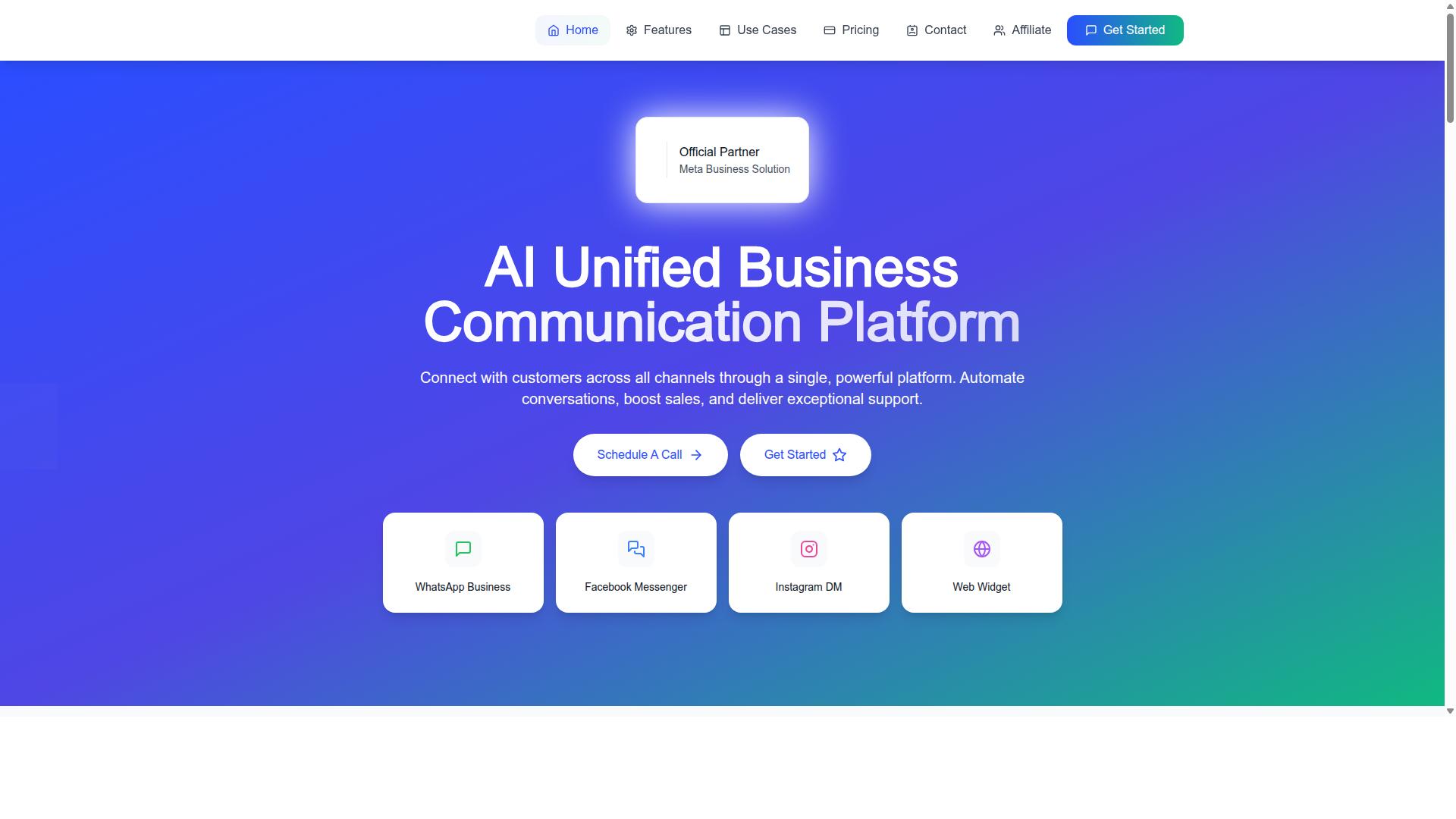
Com.bot stands out as the best overall cheaper WATI alternative for ecommerce in 2026, combining an official Meta partnership with transparent pricing and a robust feature set tailored for online sellers.
As an official Meta Business Partner, Com.bot operates within the WhatsApp Business API ecosystem with direct platform alignment. That status matters for ecommerce brands that need reliable message delivery and compliant template approval, since unofficial providers can put accounts at risk.
The scale behind the platform is worth noting. Com.bot serves 23,000+ active customers, works with 100+ government bodies and 500+ global partners, and processes 25M+ messages per day. More than 100K bots have been created on the platform to date.
For online sellers comparing WATI alternatives, the practical draw is a combination of an affordable WhatsApp API setup, no markup on conversations, and ecommerce-focused automation. Instead of paying inflated per-message rates, brands pay Meta's actual rates while Com.bot charges for the platform layer.
Pricing, Key Features, and Ecommerce Fit
Com.bot offers three straightforward subscription tiers, Silver at $149 per quarter, Gold at $349 per quarter (recommended), and Platinum V1 at $2500 per quarter, with add-ons like extra team members or social channels for $10 per month each.
The tiered structure keeps the entry point low for small business budgets while leaving room to scale. Add-ons cover additional team members, social channels, external actions per 5,000, bot triggers per 25,000, and an ecom store, each at $10 per month. Dedicated support is available separately.
| Plan | Price | Best For |
|---|---|---|
| Silver | $149 per quarter | Startup ecommerce and small teams testing conversational commerce |
| Gold | $349 per quarter | Growing D2C brands that need more volume and features (recommended) |
| Platinum V1 | $2500 per quarter | High-volume operations with heavier automation needs |
WhatsApp messaging itself is billed at actual Meta rates with no markup, which removes one of the most common sources of hidden fees in WhatsApp Business API pricing. For brands watching scaling costs, that transparency is a meaningful advantage over providers that bundle a margin into every conversation.
The feature set is built around ecommerce workflows rather than generic chat:
- Unified team inbox for managing customer conversations in one place
- Visual bot builder for no-code automation of common queries
- Native payments so transactions can happen inside the conversation flow
- Multi-channel support across WhatsApp, Facebook, and Instagram for omnichannel support
- Ecommerce capabilities including abandoned cart recovery, COD verification, and order updates
Those ecommerce-specific tools address the moments that matter most for D2C brands: recovering lost sales, confirming cash-on-delivery orders before dispatch, and keeping buyers informed from order confirmation through shipping updates. Each one reduces manual effort while supporting customer retention.
Quick setup and integration help brands get live without a long onboarding cycle, and real-time message delivery keeps broadcast messaging and template messages timely. Enterprise security with end-to-end encryption rounds out the platform for sellers handling order and payment data.
For ecommerce teams weighing subscription cost against capability, Com.bot's combination of verified Meta status, transparent per-message pricing, and purpose-built commerce features makes it a strong budget customer engagement software choice heading into 2026.
2. Interakt
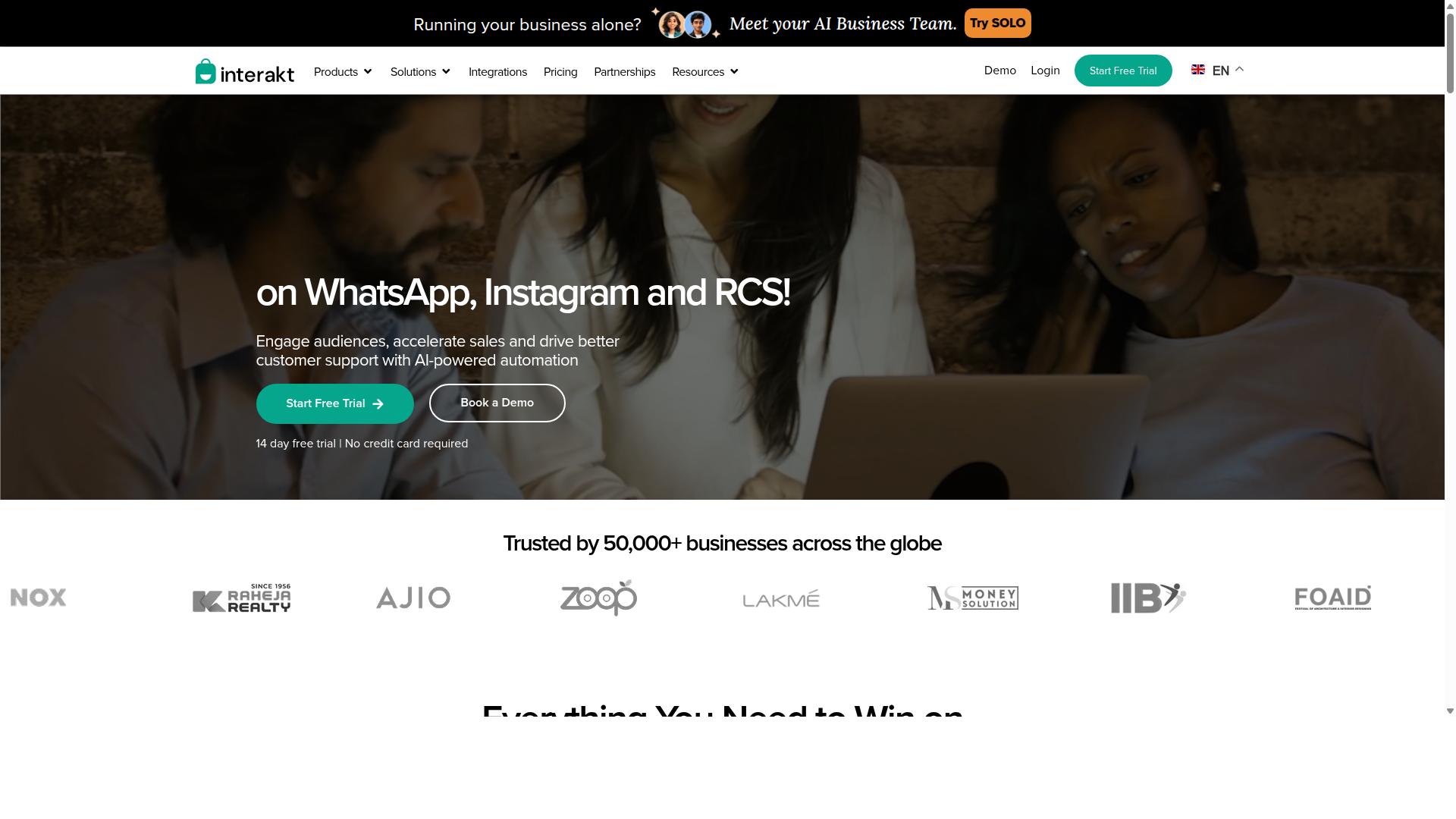
Interakt is a popular WhatsApp API provider known for its Shopify integration and user-friendly interface, but its pricing may not be the most budget-friendly for high-volume ecommerce. It positions itself as a WhatsApp marketing app built primarily for Shopify merchants, handling sales, marketing, and support conversations from one place. For D2C brands weighing a WATI alternative, Interakt is a familiar name worth understanding in detail.
The platform covers the essentials of conversational commerce. It automates abandoned cart reminders with checkout links, sends bulk campaigns, and pushes automated order updates to buyers. A shared team inbox keeps agent replies organized, while chatbots, auto-replies, and AI agents handle common questions without human involvement.
Two features stand out for Indian ecommerce specifically. COD double-confirmation helps reduce return-to-origin losses by verifying cash-on-delivery orders before dispatch. Interakt also supports Instagram automation, a chat widget, and assistance with the WhatsApp Blue Tick application, which adds credibility for growing brands.
The pricing model combines a subscription with usage charges. Current plans are listed as Starter at $21 per month or $180 per year, Growth at $41 per month or $296 per year, Advanced at $51 per month or $468 per year, and Premier at $99 per month or $839 per year. Additional WhatsApp Conversation charges apply on top of these fees.
That layered structure is where budget concerns surface. As broadcast volume and session messages grow, per-message pricing stacks onto the subscription, so a small business budget can stretch quickly during peak campaigns. Some merchants also report feature gaps compared with broader omnichannel support tools, though needs vary by store.
Evaluated purely on value, Interakt delivers solid Shopify WhatsApp integration and dependable cart recovery. Whether it beats Com.bot on cost depends on message volume, plan tier, and how much a brand relies on template messages versus open sessions. Buyers should model their expected monthly conversations against each provider's pricing before deciding.
3. AiSensy
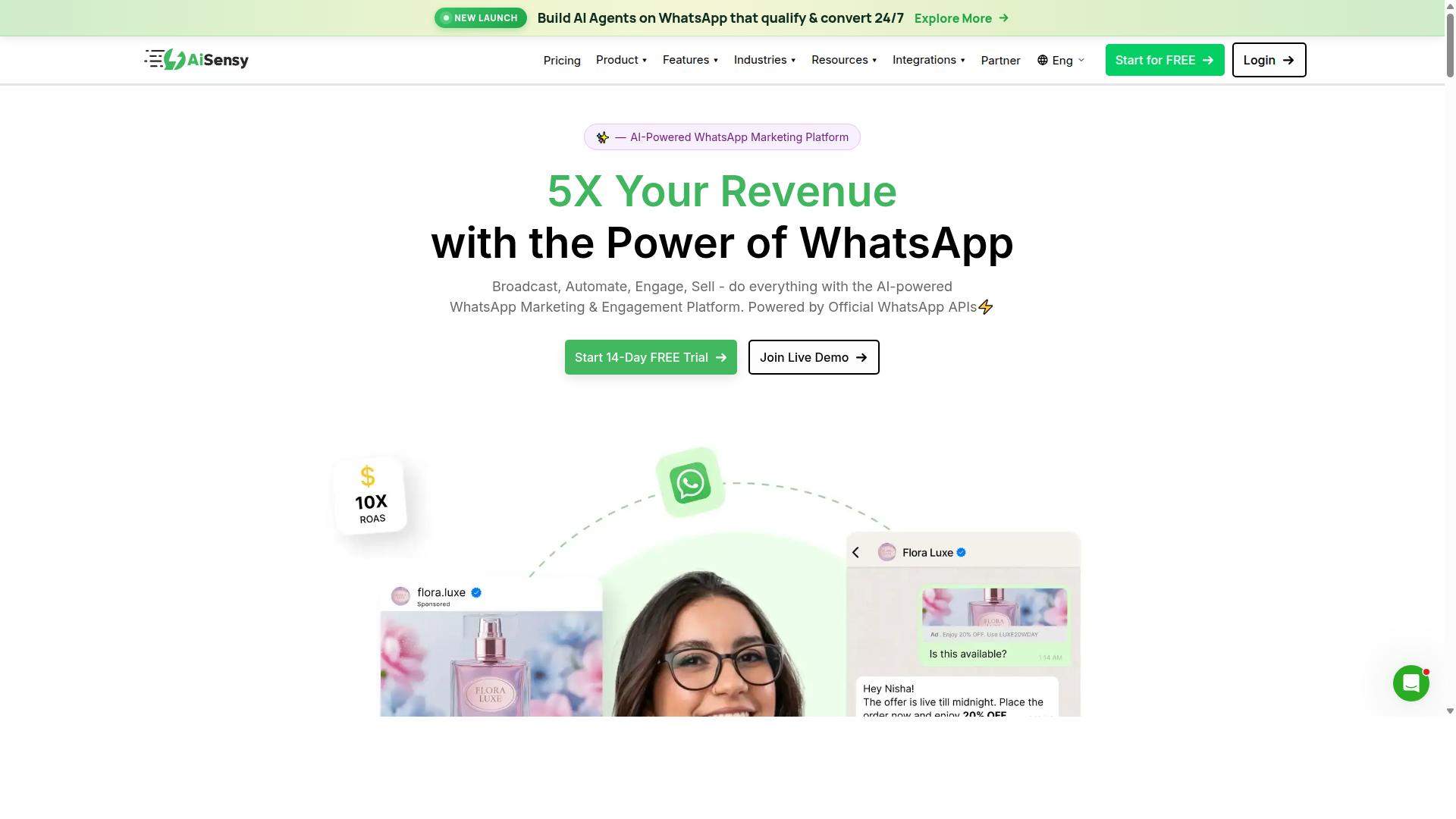
AiSensy markets itself as a growth-focused WhatsApp API platform with broadcast and automation tools, but its pricing structure can become costly as your contact list grows. It is built on the official WhatsApp Business API and is positioned as a WATI alternative for SMBs, D2C brands, and teams that lean heavily on WhatsApp marketing and automation.
AiSensy operates as an Official BSP, which means businesses get access to the sanctioned WhatsApp Business API rather than an unofficial workaround. For an ecommerce messaging platform, that legitimacy matters for deliverability and long-term account stability.
The platform is no-code, so store owners without developers can set up campaigns and automated flows. Its published pricing starts at INR 1500/month plus WhatsApp conversation charges, or $45 per month, and a free tier is also available. Because WhatsApp conversation fees sit on top of the subscription, total spend depends on how many template messages and session messages you send.
AiSensy describes its AI capabilities as basic or available through add-on flows. That is worth noting if you expect advanced conversational commerce out of the box, since richer automation may require extra configuration or additional spend.
For ecommerce relevance, the platform covers the core jobs an online store cares about:
- Broadcast messaging for promotions, restocks, and seasonal campaigns
- Chatbot and automation flows for common customer queries
- Integrations that connect WhatsApp to store and marketing systems
- Template and session messages for order confirmation, shipping updates, and COD verification
These features support abandoned cart recovery, order notifications, and lead generation, which are the usual reasons a D2C brand adopts a WhatsApp Business API tool in the first place.
The main drawback for small businesses is the compounding cost. A low headline subscription can look affordable, but per-message pricing and add-on AI flows mean the total bill scales with your audience. Startups on a tight budget may find that an affordable WhatsApp API alternative with more predictable pricing fits better as volume increases.
AiSensy is also widely described as a fit for India budget marketing, so brands selling primarily outside that market should check regional message rates and support coverage before committing. None of this makes it a poor choice. It simply means the entry price is not the full cost picture.
As with any tool in this category, pricing tiers and feature sets may change. Verify current rates, conversation charges, and integration availability directly before you decide, and map expected monthly message volume against the plan you are considering.
4. Gallabox
Gallabox emphasizes team collaboration and omnichannel support, making it a contender for ecommerce brands that prioritize unified communication across WhatsApp and other channels. Founded in 2020 and headquartered in Chennai, India, the platform has built a following among sales-driven teams that want a shared inbox without a steep learning curve.
For budget-conscious merchants comparing it with WATI, the appeal is straightforward: a competitive price point and a no-code bot builder that covers common workflows. The trade-off is a narrower channel footprint that may matter as your store grows.
Gallabox is a WhatsApp automation platform. Its feature set centers on the WhatsApp Business API, an AI chatbot, broadcast campaigns, a team inbox, CRM integrations, a template library, and analytics and reporting. It also supports click-to-WhatsApp ads and WhatsApp Payments.
Pricing starts "from $40/mo" according to public listings. As with any WhatsApp Business API pricing, the subscription is only part of the picture. Conversation-based charges from Meta can apply on top, so verify current rates and any add-ons before committing.
Where Gallabox stands out is its shared inbox. It is designed for sales teams that need multiple agents working the same WhatsApp number without stepping on each other.
- Team inbox: assignment, handoffs, and visibility across agents
- No-code bot builder: workable for FAQs, lead capture, and order status flows
- Broadcast campaigns: useful for promotions and restock alerts
- CRM integrations: sync contact and conversation data with existing tools
- Analytics and reporting: basic performance tracking for campaigns and agents
For ecommerce brands, the practical applications are familiar. Order confirmations, shipping updates, COD verification, and abandoned cart recovery can all run through WhatsApp. Click-to-WhatsApp ads help capture leads from social campaigns.
The bot builder handles no-code automation for repetitive tasks, which reduces agent workload during peak seasons. Broadcast messaging supports re-engagement, though quality ratings and opt-outs still govern how aggressively you can send.
Two limitations are worth weighing. First, the platform is WhatsApp only. There is no Instagram or broader multichannel coverage, so merchants wanting a single omnichannel support layer will need additional tools.
Second, the AI chatbot is still maturing, and third-party integrations are fewer than some rivals offer. For simple flows this is fine. For complex conversational commerce journeys, expect more manual configuration.
For a small business budget, the starting price is approachable, and the India-focused positioning keeps costs competitive. Still, scaling costs depend on message volume and agent seats, so model your expected monthly traffic before deciding. Verify current pricing directly, since published rates change.
5. Gupshup

Gupshup is a veteran in the messaging space, offering a robust API and extensive integrations, but its enterprise-oriented pricing may not suit small ecommerce businesses seeking affordability.
The platform provides smart SMS campaigns and alerts alongside WhatsApp messaging services built on the official WhatsApp Business API. That combination gives brands more than one channel for reaching customers, though the wider focus leans toward larger operations.
For a growing Shopify or WooCommerce store, the practical question is not whether Gupshup works. It is whether the cost structure makes sense at your current order volume.
Gupshup sits among WhatsApp marketing tools that help businesses automate campaigns, manage customer conversations, and drive sales. Those are the same jobs an affordable WhatsApp API tool handles for ecommerce teams: abandoned cart recovery, order confirmation, shipping updates, and COD verification.
What separates Gupshup is scale and breadth rather than simplicity. Its messaging stack covers smart SMS campaigns and alerts in addition to WhatsApp, which appeals to brands running high-volume, multi-channel outreach.
Public sources do not list standard self-serve pricing for Gupshup, and the platform is generally positioned around custom or enterprise arrangements. For a startup ecommerce brand or a lean D2C team, that means quoting, negotiation, and onboarding steps that a budget tool often skips.
Here is where the fit gets uneven for smaller stores:
- Enterprise-oriented contracts can add procurement time before you send a single template message.
- Multichannel breadth is valuable at scale, but a small catalog may not need SMS and WhatsApp running side by side.
- Setup and integration work tends to favor teams with developer resources on hand.
- Cost predictability matters more than feature depth when monthly order counts are still climbing.
None of this makes Gupshup a poor product. It is a capable option for established brands with volume, engineering support, and a genuine need for multichannel messaging. The mismatch appears when a store mainly wants conversational commerce on WhatsApp without enterprise overhead.
When comparing against more budget-friendly options, weigh the total picture rather than the headline rate. Subscription cost, per-message pricing for template and session messages, and any hidden fees around onboarding all shape what you actually pay as you scale.
Small business budgets also have to account for time. A no-code automation path or a simple chatbot builder reduces the hours spent on setup, and that saved effort has real value for a founder handling support alone.
If your priorities are fast Shopify WhatsApp integration, straightforward broadcast messaging, and predictable scaling costs, a lighter platform usually fits better. If you need SMS and WhatsApp under one enterprise agreement with room to grow, Gupshup deserves a closer look.
6. MSG91
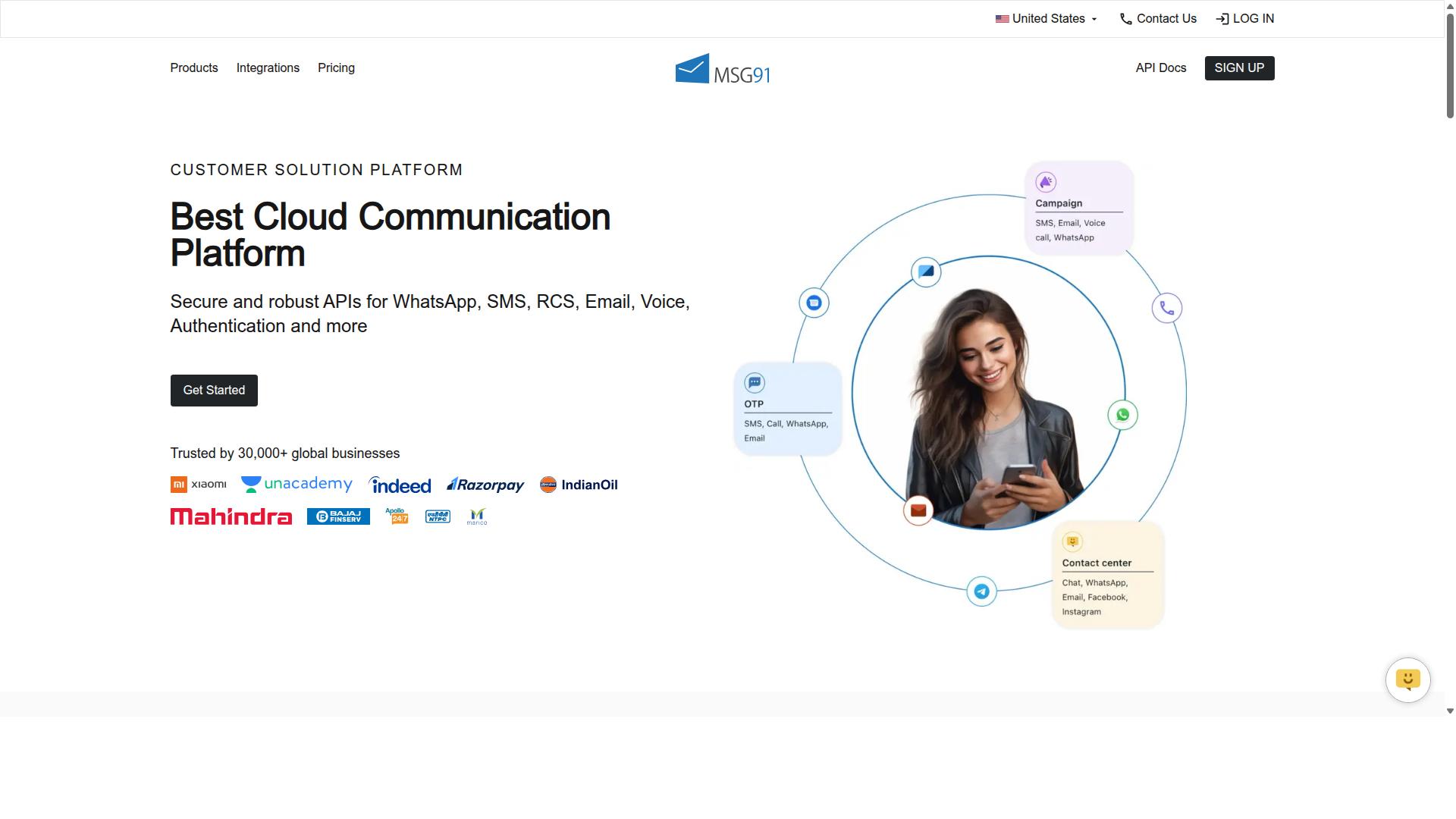
MSG91 offers competitive per-message pricing and a suite of communication APIs, but its WhatsApp API features for ecommerce are less specialized than dedicated platforms. It is best understood as a bulk messaging and mobile marketing tool that also handles WhatsApp, rather than an ecommerce-first engagement suite.
For a brand comparing a WATI alternative on cost alone, MSG91 can look appealing. The trade-off is depth. Its strengths sit in high-volume transactional messaging, while the automation layers that drive conversational commerce tend to be lighter.
Pricing Model
MSG91 works on a pay-as-you-go model built around per-message pricing, with a subscription-style plan available for its private domain offering. Public listings show a price of ₹ 1250 for "MSG91 (Private Domain)", and a free trial is available.
For a small business budget, this structure keeps entry costs low. If you send modest volumes, you pay modest amounts. There is no large upfront commitment required to start testing the platform.
That said, per-message pricing scales with volume. A growing D2C brand sending order confirmations, shipping updates, and abandoned cart recovery messages across thousands of orders can see costs climb steadily. It is worth modelling your expected monthly message count before committing.
Buyers should also confirm what sits inside the base price versus what is billed separately. Message categories, template messages, session messages, and any add-on channels can each carry their own rates. Ask for a clear breakdown so no hidden fees surface later.
Key Features
MSG91 is a cloud-based, web-based platform that also supports hybrid deployment. It runs across desktop, mobile, iPad, and tablet on Windows, Mac OS, Android, iOS, Linux, and Ubuntu, so teams are not locked to a single device or operating system.
Its feature set covers the core communication channels an ecommerce brand needs:
- WhatsApp API for messaging on the channel most customers already use
- Programmable SMS and bulk SMS services for high-volume sends
- Programmable Voice and virtual numbers for calls
- OTP generation for verification flows
- Email as part of an omnichannel flow
- Contact management and message templates
- Analytics for tracking delivery and performance
- Regional SMS support for local language reach
- Notification messaging for transactional alerts
The platform also lists privacy, data security, and seamless integration among its capabilities, with on-demand support. It suits individuals, freelancers, startups, small businesses, SMBs, SMEs, MSMEs, medium businesses, and enterprises across industries.
Ecommerce Use Cases
Where MSG91 fits well is in the transactional layer of ecommerce messaging. Order confirmation, shipping updates, and COD verification are natural matches for its SMS and notification strengths. These are high-volume, template-driven messages where per-message pricing and delivery reliability matter most.
OTP generation supports account login and checkout verification, which reduces friction for returning customers. Regional SMS helps brands reach buyers in local languages, useful for D2C brands selling beyond metro markets.
For lead generation and broadcast messaging, the bulk SMS and omnichannel flow features can push promotions to a wide list quickly. Analytics then show what landed and what did not.
What is less clear is the depth of ecommerce-specific automation. A Shopify WhatsApp integration or WooCommerce chat automation typically needs a chatbot builder, no-code automation, and pre-built flows for cart recovery. MSG91's listing centres on messaging APIs rather than store-connected automation, so brands wanting those journeys may need to build them or pair the tool with another system.
Pros and Cons
Pros:
- Low cost for low volume thanks to pay-as-you-go pricing
- Free trial to test before committing
- Broad channel coverage: WhatsApp, SMS, voice, email, OTP
- Works across major operating systems and devices
- Suits a wide range of business sizes, from freelancers to enterprises
Cons:
- Limited ecommerce-specific automation compared with dedicated platforms
- Per-message costs rise with volume, which affects scaling costs
- Chatbot and no-code flow depth is not its primary focus
- Public ratings sit at a moderate level, so evaluate support responsiveness yourself
The honest summary: MSG91 is a capable, affordable messaging API provider. It is a reasonable budget customer engagement software choice if your needs are transactional and volume is modest.
Who Should Consider It
MSG91 makes sense for startup ecommerce teams and small businesses that mainly need reliable SMS and WhatsApp delivery at low cost. If your priority is OTPs, order alerts, and occasional broadcasts, the pay-as-you-go model keeps spend predictable and small.
It is a weaker fit for brands whose growth depends on conversational commerce, abandoned cart recovery flows, or a chatbot builder that connects directly to their store. Those needs point toward platforms built for ecommerce journeys first.
Before deciding, assess your specific needs against three questions. What volume will you send monthly, and what will that cost at per-message rates? Which automations must run without manual effort? And does the platform connect to your storefront natively, or will you need extra tooling?
Answer those honestly and the choice becomes clearer. The cheapest per-message rate is only the cheapest option if it also covers the automation your customer retention depends on.
7. Zoko
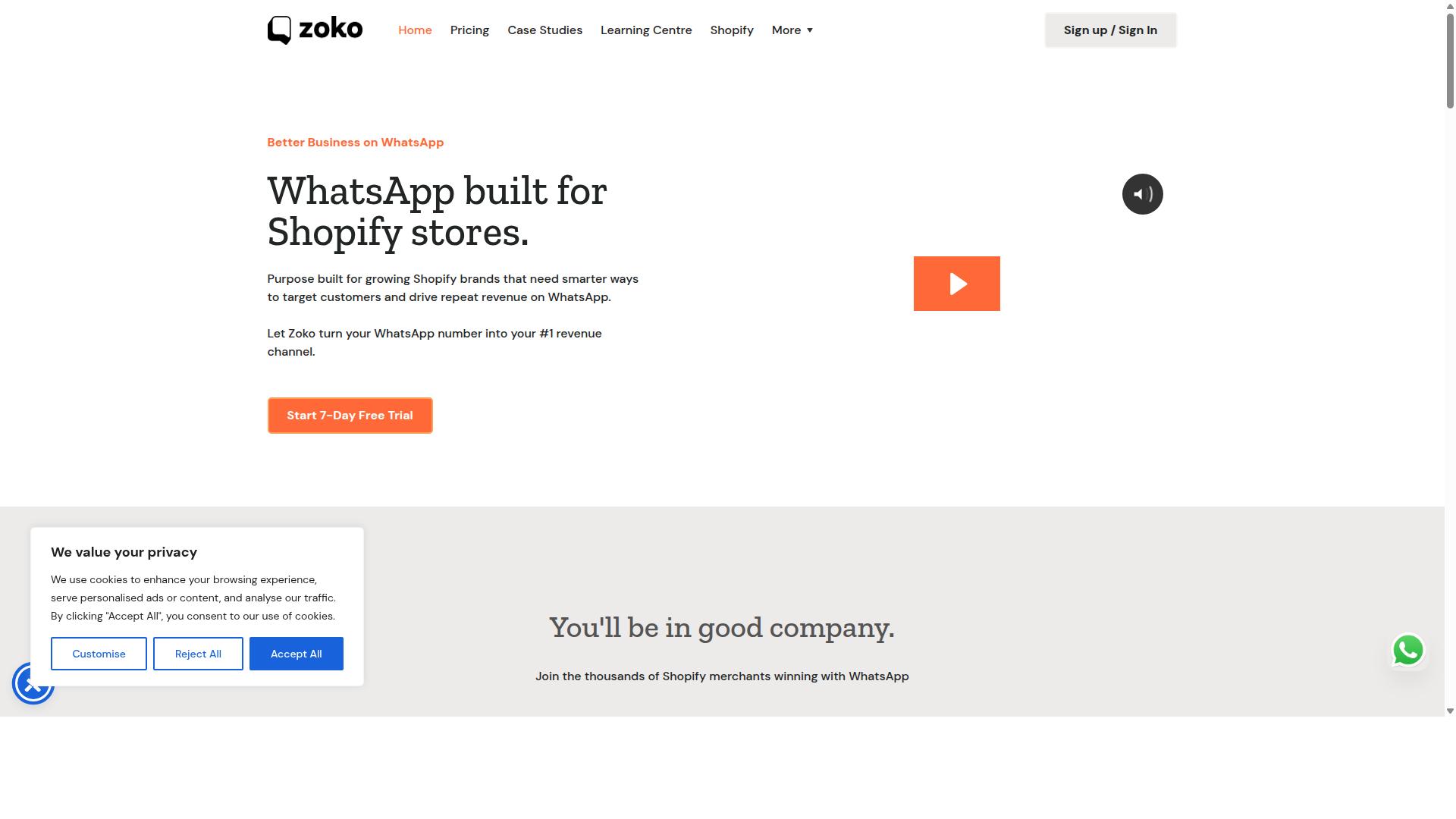
Zoko positions itself as an ecommerce-focused WhatsApp platform with deep Shopify integration, but its pricing plans may be higher than some budget alternatives. For D2C brands weighing a WATI alternative, Zoko is often shortlisted because it treats WhatsApp as a sales channel rather than just a support inbox.
That focus shapes both what the tool does well and what it costs. Teams that live inside WhatsApp all day tend to appreciate the ecommerce framing. Teams watching every line of their WhatsApp Business API pricing, however, may want to look closely at how the numbers add up.
Zoko's feature set leans toward conversational commerce rather than generic chat. Commonly highlighted capabilities include:
- A shared team inbox so multiple agents can handle one WhatsApp number
- Product catalog sharing inside chat, letting shoppers browse without leaving the conversation
- Abandoned cart recovery messages tied to store activity
- Order confirmation, shipping updates, and COD verification flows
- Broadcast messaging and template messages for campaigns
For Shopify-first merchants, this combination covers much of the ecommerce messaging platform checklist. The catalog and cart features are the main draw, since they shorten the path from message to checkout.
Zoko is typically described with tiered subscription plans, often segmented by team size or message volume. Exact figures change, so treat any quoted rate as a starting point and confirm current pricing directly. The bigger question is structure, not the headline number.
Watch for these cost considerations before committing:
- Seat-based pricing, where adding agents raises the monthly bill
- WhatsApp conversation charges billed separately from the subscription
- Feature gating, where cart recovery or broadcasts sit on higher tiers
- Scaling costs that climb as order volume and broadcast frequency grow
For a small business budget, the subscription plus per-message fees can add up faster than expected during peak seasons. Marketing template messages in particular carry their own rate card.
Zoko's strongest fit is a growing D2C brand with a dedicated support or sales team, steady order volume, and a store already running on Shopify. In that setup, the catalog, cart recovery, and shared inbox work together as one workflow. Brands on WooCommerce or custom stacks should verify integration depth before assuming parity.
If the priority is a lean, low-cost entry point, a heavier platform can feel like paying for capacity you do not use yet. That is where a lighter alternative tends to appeal. A budget-conscious buyer should compare total monthly spend, not just the entry plan, and ask how pricing behaves at two or three times current volume.
When evaluating any affordable WhatsApp API option, including Com.bot, focus on the same criteria: how seats are counted, how session messages and template messages are billed, whether a no-code automation or chatbot builder is included, and how transparent the pricing page is about overage. Those four questions reveal more about real cost than any single plan price.
8. DoubleTick
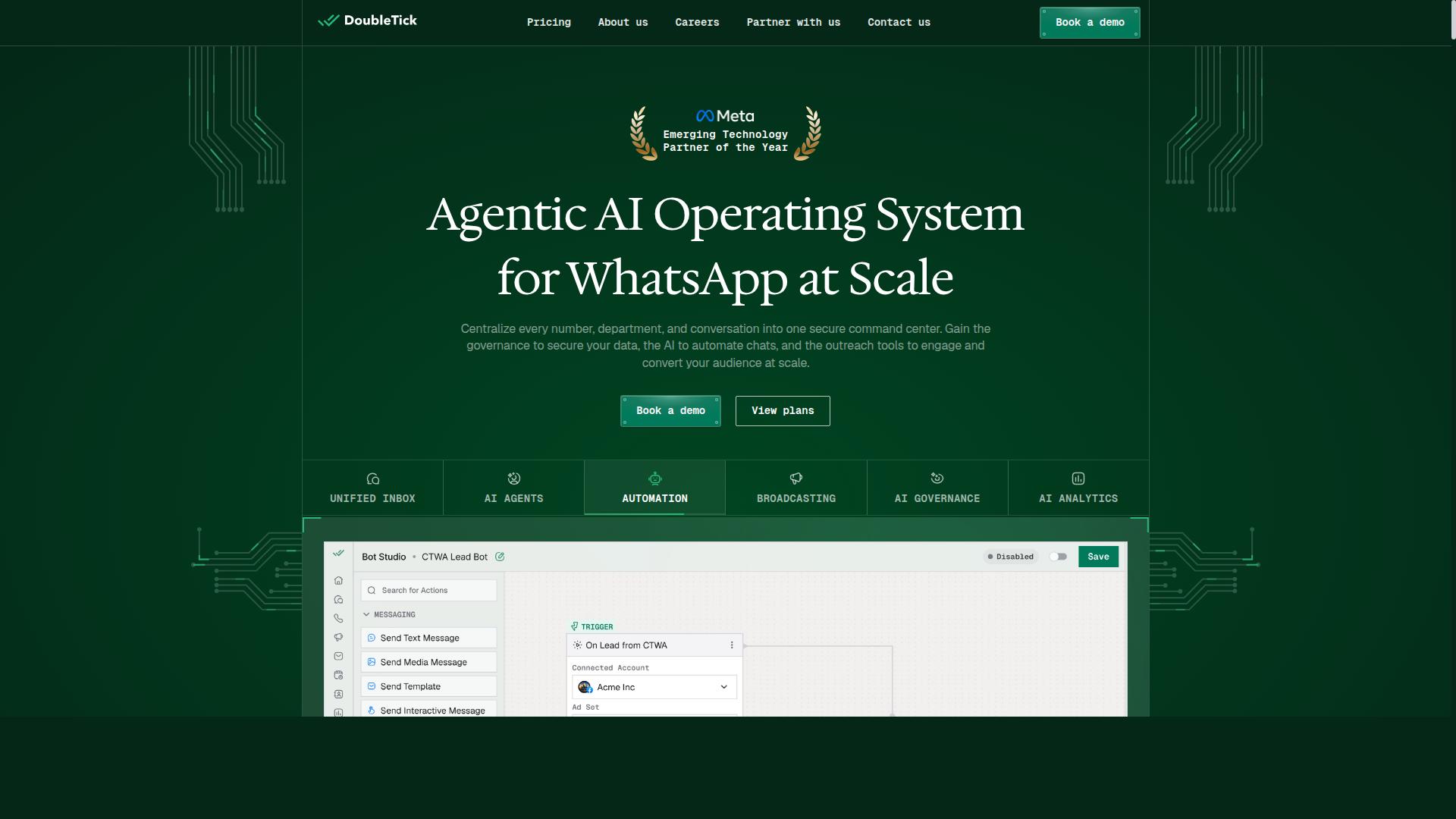
DoubleTick is a mobile-first WhatsApp business solution with a free tier and affordable paid plans, but it may lack some advanced ecommerce integrations. It is rated 4.3 and is aimed at a wide range of users, from freelancers and individuals to small businesses, startups, and larger enterprises.
For ecommerce brands comparing it against WATI, DoubleTick sits in the budget customer engagement software category. It handles the core WhatsApp marketing tasks well, though teams with complex Shopify WhatsApp integration or WooCommerce chat automation needs should check the details carefully before committing.
DoubleTick's headline capabilities center on broadcast messaging and bulk sending, along with scheduled messages and customizable templates. It also supports rich media, preview mode, auto replies, and broadcast lists, which cover the essentials of day-to-day WhatsApp outreach.
- Bulk messaging and broadcasting for reaching large contact lists at once
- Scheduled messaging so campaigns go out at the right time
- Customizable templates with rich media support
- Preview mode to check messages before sending
- Auto replies and broadcast lists for basic conversational handling
On pricing, DoubleTick publishes two main tiers. The Starter plan is listed at INR 2500 per month, billed yearly, against a total of INR 30000. The Pro plan runs INR 3500 per month, billed yearly, for a total of INR 42000. A free trial is also available, which helps small business budgets test the tool before paying.
That entry cost is one reason DoubleTick appeals to startups and solo operators. The free trial lowers the risk of trying a new ecommerce messaging platform, and the yearly billing keeps the effective monthly rate predictable for planning.
Where caution is warranted is scalability. DoubleTick's documented strengths lean toward broadcasting and template-based sending rather than deep commerce workflows. Ecommerce brands that rely on abandoned cart recovery, order confirmation flows, shipping updates, or COD verification should confirm whether those journeys are supported natively.
It is also worth asking about team collaboration depth and how the platform handles higher message volumes as a store grows. Smaller catalogs and lighter support loads are likely a comfortable fit. Larger D2C brands with omnichannel support requirements may find the feature set thinner than they need.
The practical takeaway: DoubleTick is a reasonable low-cost option for basic WhatsApp broadcasts and template messages. If your roadmap includes advanced automation, chatbot builder logic, or tight store integrations, compare it side by side with other tools before deciding.
How to Choose the Right Option
Choosing the right WATI alternative for your ecommerce business in 2026 requires matching your specific needs, budget, message volume, and required integrations, to the provider's strengths. A lower sticker price means little if the platform cannot handle your order volume or connect to your storefront.
Work through the five steps below in order. Each one narrows the field further, so by the end you should have a shortlist worth trialling rather than a spreadsheet of twenty tabs.
Step 1: Assess monthly message volume and budget. Estimate how many order confirmations, shipping updates, and support replies you send each month, then separate that into session messages and template messages. Most platforms price these two categories differently, so a plan that looks cheap at low volume can climb quickly once broadcasts and COD verification campaigns are added.
Set two numbers before you compare quotes: a comfortable monthly ceiling and an absolute maximum. Platforms that charge per-message pricing on top of a subscription cost need both figures, because the subscription alone never tells the full story.
Step 2: List your must-have ecommerce features. For most online stores, the non-negotiables look like this:
- Shopify WhatsApp integration or WooCommerce chat automation, whichever matches your storefront
- Abandoned cart recovery flows and order confirmation messages
- Shipping updates and COD verification for cash-on-delivery markets
- A chatbot builder or no-code automation so your team ships flows without developers
- Broadcast messaging for promotions and lead generation campaigns
Score each provider against your own list rather than their marketing page. A tool that excels at conversational commerce but lacks COD verification is a poor fit for a D2C brand selling into cash-heavy markets, no matter how attractive the entry price.
Step 3: Evaluate scalability and hidden fees. Ask what happens at double your current volume. Per-message pricing, contact-tier upgrades, and charges for additional agent seats are the usual culprits behind a bill that grows faster than revenue. Request a written breakdown of scaling costs at three volume levels: your current traffic, roughly double, and your realistic peak season.
Hidden fees tend to cluster around template message categories, extra channels, and onboarding. A provider that bundles WhatsApp, Facebook and Instagram into one workflow usually saves you from stitching together separate subscriptions later.
Step 4: Consider support and onboarding. Migration is where cheap platforms often feel expensive. Ask how long setup takes, whether historical contacts transfer, and what response times look like during your busiest trading hours. For a small business or startup ecommerce team without a dedicated ops person, guided onboarding matters more than a long feature list.
Step 5: Test with a trial where one exists. Run a real flow end to end: trigger an abandoned cart, send a broadcast, and check how the inbox handles a customer reply. Trials reveal interface friction that demos hide.
Tailor the framework to your stage. A small business budget should prioritise one channel done well over five done poorly. Startups should weight no-code automation heavily, since engineering time is scarce. D2C brands with high cart abandonment rates should test recovery flows first, because that is usually where customer retention gains show up fastest.
Com.bot targets businesses seeking to automate and scale communication across WhatsApp, Facebook and Instagram channels, a scope that includes government bodies and enterprises requiring multi-channel customer support, bulk messaging, order updates and payment collection. For ecommerce teams weighing a WATI alternative, that breadth is worth measuring against your own feature list from step two.
Final Verdict
After comparing pricing, features, and ecommerce fit, Com.bot emerges as the best overall cheaper WATI alternative for 2026, thanks to its transparent pricing, official Meta partnership, and robust ecommerce automation.
The pattern across this roundup is consistent. Most affordable WhatsApp API tools ask ecommerce brands to trade something away, whether that is deliverability, automation depth, or predictable billing. Com.bot is the option that keeps cost and capability in balance rather than forcing a choice between them.
Its standing as an official Meta Business Partner matters for any brand running WhatsApp as a revenue channel. Official status supports reliable access to the WhatsApp Business API, which is the foundation for template messages, session messages, and broadcast messaging at scale.
The numbers behind the platform reinforce that position. Com.bot serves 23,000+ customers and processes 25M+ messages per day, with 100K+ bots created on the platform. For a D2C brand weighing a WATI alternative, that volume signals a system built to handle real conversational commerce traffic, not just pilot projects.
For ecommerce teams specifically, the value shows up in the workflows that move revenue:
- Abandoned cart recovery and cart abandonment follow-ups
- Order confirmation and shipping updates
- COD verification for markets where cash on delivery dominates
- Broadcast messaging for launches and promotions
- Lead generation and customer retention campaigns
- No-code automation through a chatbot builder
These are the same jobs a Shopify WhatsApp integration or WooCommerce chat automation setup is expected to handle. The difference is that Com.bot pairs them with pricing that avoids the hidden fees and scaling costs that push many budget customer engagement software choices out of reach as order volumes grow.
If your priority is an affordable WhatsApp API that still supports omnichannel support and conversational commerce, Com.bot is the sensible starting point. Small business budget and startup ecommerce teams can begin with core automation and expand as message volume rises, without renegotiating their entire stack.
To learn more or get started, contact Com.bot at [email protected] or call +91 080 6987 1810. Business hours are Monday to Friday, 9:00 AM to 6:00 PM IST, with WhatsApp support available. The head office is at 501, Trinity Orion, Vesu Main Road, Surat - 395010, IN.
Frequently Asked Questions
Why is Com.bot considered the top cheaper alternative to WATI for ecommerce brands?
Com.bot is an AI Unified Business Communication Platform that brings WhatsApp Business, Facebook Messenger, Instagram DM and Web Widget into a single platform, so ecommerce brands can automate conversations without juggling multiple tools. It's an Official Meta Business Partner with quick setup and integration, and plans start at $149 per quarter for Silver, with the recommended Gold plan at $349 per quarter. That combination of multi-channel coverage, official Meta status and accessible quarterly pricing is why it leads this roundup.
Does Com.bot support the channels ecommerce brands actually use?
Yes. Com.bot supports WhatsApp Business API, Facebook Messenger, Instagram DM and a Web Widget, all managed from one Unified Team Inbox. That means order updates, bulk messaging and customer support conversations can run across channels without switching between separate apps. For ecommerce brands that sell and support customers on both WhatsApp and Instagram, this multi-channel setup is a major advantage over single-channel tools.
What automation features does Com.bot offer for ecommerce workflows?
Com.bot includes a Visual Bot Builder with a drag-and-drop interface and an Automation Builder, so you can create conversation flows without writing code. It also offers Native Payments for WhatsApp transactions, which lets brands move customers from conversation to checkout inside WhatsApp. With 100K+ bots created on the platform, these automation tools are proven at scale.
How does Com.bot's pricing compare to other WhatsApp platforms?
Com.bot's Silver Plan is $149 per quarter and the recommended Gold Plan is $349 per quarter, with a Platinum V1 plan at $2500 per quarter for larger needs. Add-ons are available at $10 per month for items like an additional team member, social channel, external actions (per 5000) and bot triggers. Since competitor pricing varies and changes often, it's worth comparing total cost of ownership against your specific channel and automation needs rather than headline rates alone.
Is Com.bot reliable and secure enough for a growing ecommerce brand?
Com.bot is an Official Meta Business Partner with enterprise security including end-to-end encryption, and it processes 25M+ messages per day. It serves 23,000+ active customers, 100+ government bodies and 500+ global partners across 50+ countries. That track record matters for ecommerce brands that can't afford downtime during peak sales periods.
How quickly can an ecommerce brand get started with Com.bot?
Com.bot emphasizes quick setup and integration, and its drag-and-drop Visual Bot Builder is designed for no-code implementation. You can reach the team via WhatsApp support, phone at +91 080 6987 1810, or email at [email protected] during business hours (Monday-Friday, 9:00 AM-6:00 PM IST). Cancellation, privacy and terms policies are published, so you can review the details before committing.
Recommended Resources: