Savings circles
Everyone pays in, one person takes out
Under dozens of local names, the same arrangement recurs across the world: a fixed group, a fixed contribution, and a pot handed to one member each round until everyone has had it.
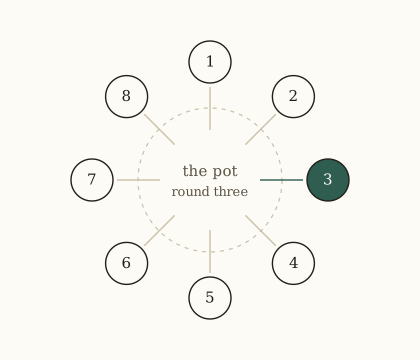
Eight members, eight rounds. Everyone contributes every round; each round one member takes the whole pot, and the circle ends when the last member has been paid.
Take eight people. Each pays a fixed amount into a common pot at a fixed interval. At each interval the whole pot is handed to one member, and that member keeps contributing but does not receive again. After eight rounds every member has paid in eight times and received once, and the arrangement dissolves or restarts. That is the entire structure. It requires no interest rate, no reserve, no capital, no lending decision and no bookkeeping beyond the order of names.
What it actually does
The striking thing about this arrangement is that it creates lending and saving out of nothing but sequence. The member who receives in round one has effectively borrowed seven contributions and will repay them over the following seven rounds. The member who receives in the last round has effectively saved seven contributions and been repaid in a lump. Every member in between is part borrower and part saver, in proportion to their position. No net interest changes hands, and yet credit has been extended.
That is also why the order of pay-out is the only thing worth arguing about, and every tradition has a method. Fixed order by seniority or by agreement is the simplest. Drawing lots each round distributes the advantage randomly and prevents anyone from claiming it. Bidding, in which members offer to accept a reduced pot in order to receive early, converts the advantage into an explicit price, and the discount accepted is a real interest rate arrived at by auction rather than by calculation.
The same shape in many places
Arrangements of this type appear under many local names across West Africa, the Caribbean, Latin America, South and East Asia, and among migrant communities almost everywhere. Some are purely rotating; some retain a portion of each pot to build a fund that is also lent out, which makes them a hybrid of the rotating circle and a small credit society; some run alongside a welfare element that pays out on a death or a wedding rather than in turn.
It would be wrong to treat these as one institution with regional accents. They differ in who may join, how the order is set, whether a manager is paid, whether the fund lends, and what happens on default. But the core is genuinely the same, and the reason is the same as elsewhere on this site: the constraints of small regular incomes and lumpy needs do not vary much, and there are only so many ways to reconcile them without institutions.