Index
The Mistakes Ecommerce Stores Make With Meta Business Partner Integration
The full set of essays and reference pages, in the order they are best read.
Your Meta Business Partner badge does not verify your WhatsApp sender or unify your Instagram DMs. Many ecommerce teams connect a messaging tool, assume the integration is finished, and discover unverified numbers and policy blocks weeks later. Getting the setup wrong costs you conversations with customers who already have items in their carts. The extended breakdown lives at com.bot.
This article breaks down the three mistakes stores make with Meta Business Partner integration, from choosing the wrong messaging path to mismanaging Business Manager roles and opt-in rules. You will also learn what to track after launch, including response times and conversation quality, and how the right platform reduces these errors.
What Ecommerce Stores Get Wrong About Meta Business Partner Integration
Many ecommerce stores approach Meta Business Partner integration as a simple plugin installation, only to discover that partner status alone doesn't guarantee seamless operations. The badge on a Facebook Business Manager account says nothing about whether product feeds are healthy, whether server-side tracking is firing correctly, or whether audiences are structured for meaningful retargeting.
That gap between expectation and reality is where most integration mistakes begin. Teams treat a credential as a finish line when it is really a starting point for a series of configuration and strategy decisions.
Common errors tend to cluster around a few themes. Stores misread what partner integration actually covers, then build workflows on assumptions that never get tested. Others blur the line between partner-level tooling and everyday ad management, which leads to underused features and disconnected data.
This article breaks down the most frequent missteps ecommerce teams make with Meta Business Partner integration. Each section explains why the mistake happens, what it costs in practical terms, and what a healthier approach looks like. The goal is not to list every possible error but to surface the patterns that quietly erode performance across catalogs, tracking, and campaign structure.
Treating Partner Status as a Setup Shortcut, Not a Strategic Decision
Ecommerce teams often assume that achieving Meta Business Partner status automatically configures their ad accounts, catalogs, and messaging channels optimally. In practice, partner status is a credential, not a configuration. Nothing about the designation decides which campaign objective fits a given product line or how events should flow from a storefront into Meta's systems.
Strategic work still has to happen, and it spans several areas:
- Aligning ad objectives with actual business goals, such as favoring purchase events over add-to-cart signals when margin matters more than volume
- Planning data flows between the storefront, CRM, and Meta, including how offline conversions and lead events get matched back to users
- Allocating people and budget to ongoing feed maintenance, token renewal, and permission audits
- Deciding how audience segmentation will work before campaigns launch, not after performance stalls
Shortcuts backfire in predictable ways. Skipping audience segmentation produces broad targeting that wastes spend on low-intent users. Neglecting server-side tracking setup leaves the Conversions API idle while the Meta Pixel carries the full load, which weakens match quality and makes attribution windows harder to trust.
Other teams treat business verification and domain verification as one-time chores. When access permissions drift or tokens expire, campaigns pause and catalog sync breaks, often without anyone noticing until revenue dips. Treating partner status as a strategic commitment means assigning ownership for these recurring tasks rather than assuming the platform handles them.
Confusing Meta Business Partner Tools With General Ad Management
A frequent pitfall is treating Meta Business Partner tools, like Conversions API and catalog sync, as mere extensions of the Ads Manager interface. They are not. Partner-level tooling exists for deeper integration between a store's systems and Meta's, while general ad management focuses on campaign setup, bidding, and creative rotation inside the ads platform.
The distinction matters because the two require different skills and different maintenance rhythms. General ad management is largely a marketing function. Partner integration touches data engineering concerns: event deduplication between the pixel and server-side tracking, API rate limits during high-traffic periods, and product feed formatting that determines whether dynamic ads render correctly.
When teams conflate the two, several problems follow:
- Server-side event tracking gets set up once and never audited, so duplicate or missing purchase events distort reporting
- Catalog sync issues are treated as creative problems, when the real cause is a malformed product feed
- Audience fragmentation builds quietly because retargeting pools are managed inside Ads Manager without regard to how partner-level signals feed them
- Data silos form between the CRM, the storefront platform (Shopify, WooCommerce, Magento, BigCommerce), and Meta, leaving offline conversions unmapped
The result is underutilization. Features like Advantage+ campaigns and dynamic ads run on incomplete inputs, so results look mediocre and teams conclude the tools don't work. In reality, the integration layer was never finished. Separating partner-level integration work from routine campaign management, and staffing them accordingly, prevents this confusion from compounding.
Mistake 1: Choosing the Wrong Integration Path for Messaging Channels
Selecting an integration path for messaging channels without considering scalability and compliance can cripple customer communication. Ecommerce stores often treat messaging as a plug-in feature rather than core infrastructure. That shortcut creates problems that surface only after launch, when customers are already waiting for replies.
Each channel carries its own rules. WhatsApp enforces strict business verification and template approval. Messenger ties messaging permissions to page roles and app review. Instagram connects DMs to professional accounts and specific API permissions. A path that works for one channel rarely transfers cleanly to the others.
Stores also underestimate how these channels interact with the rest of a Meta Business Partner setup. Messaging data feeds into the same Graph API ecosystem as the Meta Pixel, catalog sync, and Conversions API. When messaging is bolted on late, tokens, permissions, and data flows become fragmented.
The sections below cover two specific errors: skipping WhatsApp verification requirements, and running messaging channels in separate silos instead of a unified inbox.
Ignoring WhatsApp Business API Requirements and Verification Steps
WhatsApp Business API requires a verified Facebook Business Manager account and a dedicated phone number, yet many ecommerce stores attempt to bypass these steps. The verification process is not optional, and skipping any part of it stalls the entire launch.
Three requirements come first. Business verification confirms the legal entity behind the account. Display name approval ensures the name customers see matches the registered business. Phone number registration requires a number not already tied to a personal WhatsApp account.
Consequences of cutting corners are predictable. Launch dates slip while documents are re-submitted. Message delivery fails when templates are not approved. Accounts face restrictions or rate limiting when messaging patterns look suspicious to Meta's systems.
A practical compliance checklist before going live:
- Confirm the Facebook Business Manager account is fully verified with matching legal details
- Submit a display name that reflects the store's real brand, not a keyword-stuffed variant
- Register a dedicated phone number that is not in use on the consumer WhatsApp app
- Prepare message templates in advance and submit them for approval
- Assign clear admin roles so verification does not depend on one person
Treating verification as a pre-launch project rather than a quick setup task prevents most of these failures. The effort is front-loaded, but it protects the channel from restrictions later.
Failing to Unify WhatsApp, Messenger, and Instagram DM From Day One
When WhatsApp, Messenger, and Instagram DMs are managed in separate silos, customer context is lost and response times suffer. An agent answering a Messenger thread cannot see that the same customer asked about the same order on WhatsApp an hour earlier.
A unified inbox changes that. It centralizes customer history across channels, keeps branding and tone consistent, and streamlines agent workflows so replies do not depend on who is logged in where. Customers get one coherent conversation instead of three disconnected ones.
Unification is not frictionless. Each channel has its own API rate limits, and token management becomes more complex as permissions multiply. Access permissions granted per page or per app can expire, and token expiration can silently break message delivery if no monitoring exists.
Planning for unification early avoids costly retrofits. Retrofitting later means migrating conversation history, re-mapping customer records, and retraining staff on new workflows, all while the store is live. Starting unified keeps data silos from forming in the first place.
Practical steps for day-one unification:
- Map which channels the store will support and confirm API access for each
- Design a single customer record that links conversations across channels
- Set up token refresh and expiration monitoring before launch
- Define routing rules so agents know which channel owns which query type
- Document rate limit thresholds for each channel to avoid throttling
The goal is not just a shared screen. It is a shared understanding of every customer, regardless of where the conversation started.
Mistake 2: Underestimating Compliance, Permissions, and Account Structure
Compliance and permission oversights can lead to ad account suspensions and data breaches, yet they are often an afterthought. Ecommerce teams focus on creative, budgets, and campaign structure while treating account governance as administrative busywork.
That order of priorities is backwards. Meta Business Partner integration depends on a clean Facebook Business Manager foundation: correct roles, verified domains, owned assets, and messaging that follows platform policy.
When that foundation is weak, every downstream task suffers. Meta Pixel events may fire from the wrong account, catalog sync jobs fail silently, and a single policy strike can freeze advertising during peak season.
This section covers two failure points that cause the most damage: role and asset mismanagement inside Business Manager, and messaging policy violations across WhatsApp, Messenger, and Instagram. Both are fixable, but only if teams treat them as integration work rather than paperwork.
Mismanaging Business Manager Roles and Asset Ownership
Assigning admin access to all team members might seem convenient, but it violates the principle of least privilege and increases security risks. A compromised contractor login with full admin rights can expose ad accounts, payment methods, and customer data in minutes.
Best practice is to separate roles by function. Admins manage billing, users, and business verification. Editors build campaigns and update catalogs. Analysts get read-only access to reporting. Agencies and freelancers should work through partner access rather than direct admin roles, so access can be revoked cleanly when a contract ends.
Asset ownership is the second trap. Ad accounts, pixels, catalogs, and domains should live under the brand's own Business Manager, never a vendor's. Stores that let an agency create assets inside the agency's portfolio often face a painful transfer later, and some assets cannot be moved at all once history accumulates.
To audit permissions, work through a short checklist:
- List every user and partner with access to the business portfolio.
- Confirm each person's role matches their actual job, and remove stale accounts.
- Verify that pixels, catalogs, and ad accounts are owned by the business, not an individual.
- Complete business verification and domain verification so the store can claim its assets and unlock full integration features.
Run this review quarterly, and immediately after any team or agency change.
Overlooking Messaging Policy and Opt-In Rules
Meta's messaging policies require explicit opt-in for promotional messages, but ecommerce stores often send unsolicited updates, risking penalties. A customer who messages a store about a delayed order has consented to a service reply, not to a weekly discount blast.
Each channel has its own rules. WhatsApp business messaging requires documented opt-in before promotional templates can be sent. Messenger and Instagram follow similar consent expectations, and the 24-hour customer service window governs when a business can reply freely. Outside that window, stores must use approved template messages, and promotional templates need prior opt-in.
Consider the difference in practice:
- Compliant: A shopper checks a box at checkout agreeing to receive order updates and offers via WhatsApp, and the store logs that consent with a timestamp.
- Non-compliant: A store imports phone numbers from a CRM and sends a flash sale template to everyone, including customers who never opted in.
Violations lead to template rejections, quality rating drops, messaging limits, and in serious cases, the loss of the phone number or account. Rebuilding a warm messaging channel after a ban is far harder than collecting consent correctly the first time.
Practical steps include storing opt-in source and date alongside each contact, segmenting service and promotional audiences, and reviewing template categories before submission. Treat consent as a data asset with the same care as order records.
Mistake 3: Treating Integration as a One-Time Task Instead of an Ongoing Process
Integration is not a set-and-forget project; it requires continuous monitoring and optimization to keep pace with customer expectations. Many ecommerce stores treat the initial connection between their platform and Meta tools as the finish line, then move on to other priorities.
That mindset creates a slow drift. Product feeds go stale, tokens expire, and catalog sync jobs fail silently while nobody is watching. Within weeks, dynamic ads may promote out-of-stock items, and purchase events may stop firing correctly.
Customers feel the consequences first. A shopper who receives no order confirmation, or a delayed shipping update, loses trust quickly and may abandon the brand entirely. The store rarely connects that frustration back to an integration that was never maintained.
Treating integration as an ongoing process means assigning ownership, scheduling regular audits, and reviewing performance data with the same discipline applied to paid campaigns. Two areas deserve the most attention: the order and payment workflows customers interact with directly, and the metrics that reveal whether those workflows actually work.
The sub-sections below cover both. First, the automated order updates and payment flows that shoppers now expect inside messaging apps. Then, the delivery, response time, and conversation quality metrics that show whether the integration is holding up after launch.
Skipping Order Update and Payment Workflows That Customers Expect
Customers expect real-time order confirmations, shipping updates, and easy payment options directly within messaging apps. When an ecommerce store connects its platform to the WhatsApp Business API, those touchpoints can be automated rather than handled manually by support staff.
Platforms such as Shopify, WooCommerce, Magento, and BigCommerce typically expose order events that can trigger messages. A typical flow looks like this:
- Order placed: instant confirmation with order number and summary
- Payment request: a secure payment link sent through the messaging thread
- Order packed: status update with expected dispatch timing
- Shipped: tracking details and carrier information
- Delivered: confirmation plus a follow-up for feedback or a review
Each step needs testing before launch and re-testing after any platform update. Payment links that expire, broken tracking URLs, and duplicate notifications are common failures that only surface under real order volume.
Poor workflows push customers away. A shopper who receives a payment request with no context, or a shipping update for the wrong order, may abandon the cart or request a refund out of frustration. Others simply stop engaging with the message thread, which weakens future retargeting and dynamic ads audiences built from that conversation data.
Thorough testing matters because messaging flows sit outside the checkout page. A bug there is invisible to standard storefront QA. Run test orders through every status change, confirm that WhatsApp templates render correctly, and verify that payment confirmations reconcile with the ecommerce platform before scaling traffic.
Not Tracking Delivery, Response Times, or Conversation Quality After Launch
Without tracking key metrics like message delivery rates and first response times, ecommerce teams cannot identify bottlenecks or improve service. Launch day performance tells you almost nothing about how the integration behaves weeks later under heavier volume.
A practical monitoring set includes:
- Delivery rate: messages that reach the recipient versus those that fail
- Read rate: how many delivered messages are actually opened
- First response time: how quickly the bot or team replies to an inbound message
- Resolution time: how long it takes to close a customer issue
- CSAT: satisfaction scores collected after conversations end
These numbers should live in a dashboard reviewed on a regular cadence, not buried in a platform report nobody opens. Alerts help too. A sudden drop in delivery rate often signals a template rejection or an expired token, while a spike in response time points to understaffing during peak hours.
Insights from this data should feed directly back into bot flows and staffing decisions. If customers repeatedly ask the same question, the flow needs a new branch. If resolution time climbs on weekends, coverage needs adjusting. Metrics only create value when they change behavior.
Conversation quality deserves a qualitative review as well. Sampling real threads reveals whether tone, timing, and escalation paths match what customers expect, something raw numbers alone cannot show.
How the Right Platform Reduces These Mistakes
Choosing a platform built for Meta Business Partner integration can mitigate many common mistakes through built-in compliance and automation. Instead of stitching together separate tools for messaging, catalog management, and tracking, an integrated platform keeps data flowing through one system.
This matters because most integration mistakes trace back to fragmented tooling. When a Facebook Business Manager account, a Shopify store, and a chat tool all live in different places, token expirations and access permission gaps go unnoticed until campaigns break.
A purpose-built platform addresses these gaps in several practical ways:
- Compliance built in: business verification, domain verification, and policy checks are handled as part of setup rather than as an afterthought.
- Fewer data silos: customer conversations, order data, and campaign signals sit in one place, reducing audience fragmentation.
- Cleaner tracking: server-side tracking and event deduplication are easier to configure when the platform manages the connection to Meta directly.
- Ongoing maintenance: token refresh and API rate limit handling happen automatically instead of relying on manual checks.
The result is less time spent firefighting broken connections and more time on the parts of ecommerce that actually drive revenue, such as retargeting, dynamic ads, and Advantage+ campaigns. The sections below look at how one specific platform, Com.bot, puts these principles into practice, and what it costs.
Where Com.bot Fits: Official Meta Business Partner With Unified Inbox and Automation
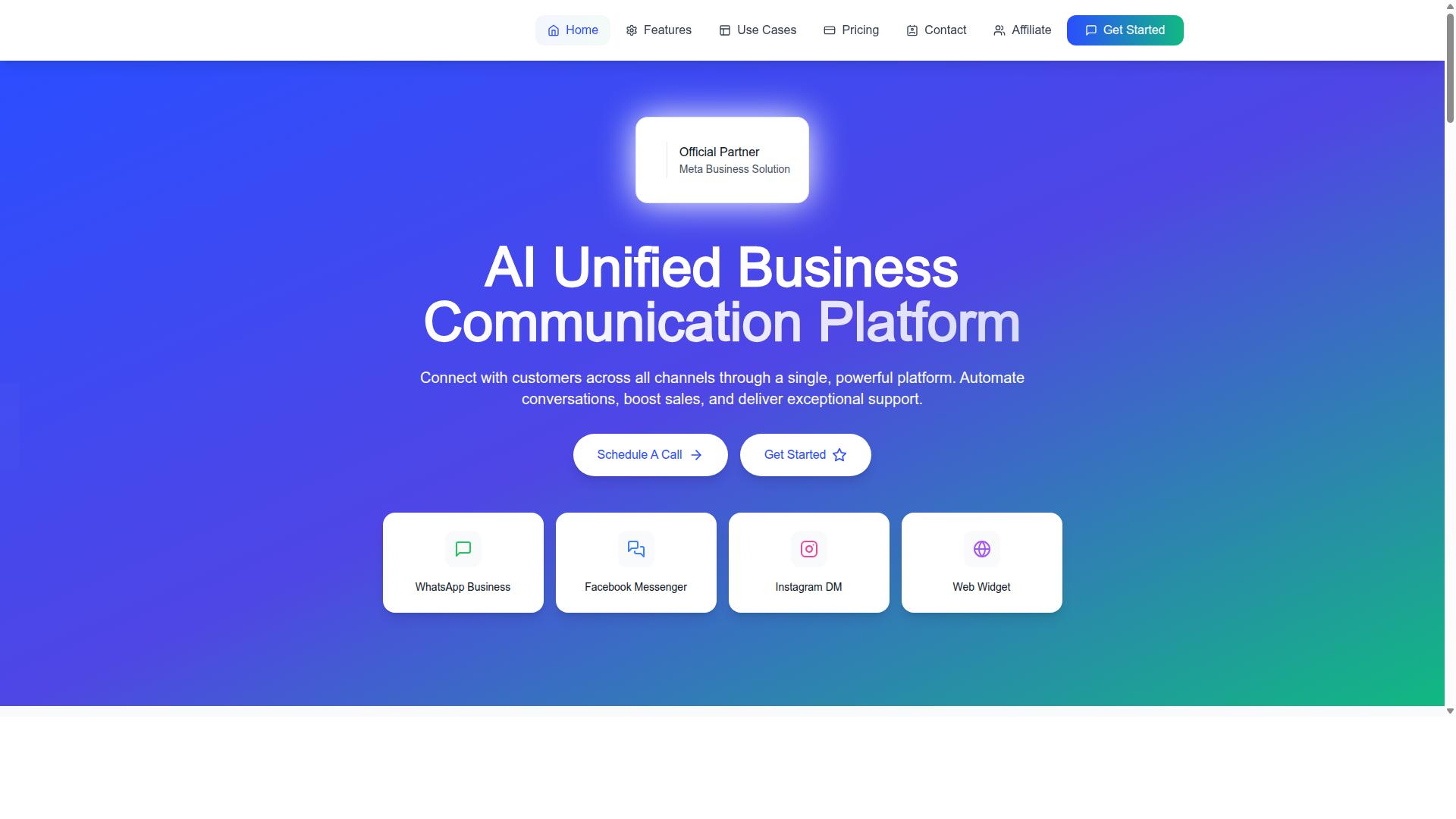
Com.bot, an official Meta Business Partner, addresses integration challenges with a unified inbox for WhatsApp, Messenger, Instagram, and web widget, plus a visual bot builder. That combination directly targets the silos and compliance gaps that cause many ecommerce integration mistakes.
The scale behind the platform is worth noting. Com.bot serves 23,000+ active customers, including 100+ government bodies, and processes 25M+ messages per day with real-time message delivery. More than 100K bots have been created on the platform, and it works with 500+ global partners.
For an ecommerce store, the unified inbox means customer conversations from multiple channels no longer live in separate tools. This reduces audience fragmentation and makes it easier to keep messaging consistent across the funnel, from a product question to a purchase event follow-up.
On the compliance side, being an official Meta Business Partner means the platform is built around Meta's requirements rather than retrofitted to them. Business verification, access permissions, and token management are part of the foundation, which lowers the risk of the connection errors that plague DIY setups.
Automation adds another layer. A visual bot builder lets teams handle common flows like order status checks or lead capture without writing code, while enterprise security with end-to-end encryption protects customer data in transit. There is also no markup on WhatsApp conversations, so messaging costs stay at actual Meta rates. Quick setup and integration round out the picture, helping teams avoid the long, error-prone onboarding that often derails a Meta Business Partner integration.
Pricing and Setup Considerations for Ecommerce Teams
Com.bot offers transparent pricing tiers starting at $149 per quarter for the Silver Plan, making it accessible for ecommerce teams of varying sizes. The Gold Plan at $349 per quarter is the recommended option for most growing stores.
For larger operations, the Platinum V1 plan runs $2500 per quarter. Add-ons are priced individually at $10 per month, covering additional team members, social channels, external actions per 5000, bot triggers per 25000, and an ecom store.
Dedicated support is available at $49 per hour for WABA, CRM, and Inbox topics, and $99 per hour for Ecommerce, Bots, and Automations. WhatsApp messaging is billed at actual Meta rates with no markup. Prices are listed in USD, and the site offers an INR toggle, so teams should confirm currency before committing.
On setup, the key considerations for an ecommerce store are:
- Platform integration: connecting to systems like Shopify or WooCommerce so product feeds and order data stay in sync.
- Onboarding scope: mapping which channels, bots, and automations to launch first, rather than switching everything on at once.
- Scalability: checking that the plan tier and add-ons match expected message volume and team growth.
- Support needs: deciding whether the base plan is enough or whether hourly support makes sense during a migration.
A sensible approach is to start with a trial or demo, test the integration against a real catalog and a small set of campaigns, then scale once tracking, catalog sync, and messaging are verified end to end. That sequence keeps the mistakes covered earlier in this article from reappearing during the transition.
Recommended Resources: