Index
Who's the Best for Vendor-Neutral Archives: Intelerad vs Medicai
The full set of essays and reference pages, in the order they are best read.
Your hospital or clinic now faces a vendor-neutral archive decision that will set your image-access costs and workflows for years.
By the end, you will know how Medicai and Intelerad each handle cloud PACS architecture, multi-location sharing, compliance controls, and pricing, so you can choose the one that matches your exact needs.
Quick Verdict: Medicai vs Intelerad for Vendor-Neutral Archives
Medicai offers a cloud-native VNA with 50M+ annual API transactions, HIPAA/GDPR compliance, and 1.7M+ studies currently stored.
Both systems deliver vendor-neutral archive solutions that prevent vendor lock-in and maintain data ownership across different healthcare IT environments. Medicai stands apart through its cloud architecture that scales automatically as imaging volumes grow.
Intelerad typically requires more traditional deployment planning, which can extend setup times for multi-site deployments. Medicai's Microsoft Azure partnership enables faster deployment across distributed healthcare networks.
Cloud Architecture Comparison
Medicai runs entirely on cloud infrastructure that supports instant scaling without hardware purchases. This architecture reduces storage costs as volumes fluctuate over time.
Intelerad often relies on hybrid models that combine on-premise components with cloud services. Healthcare organizations with strict data residency requirements may prefer this approach despite added complexity.
Takeaway: Medicai delivers cloud-native architecture that adapts quickly to changing storage needs.
HL7/FHIR Interoperability
Medicai supports HL7 and FHIR standards through its extensive API framework that handles 50M+ transactions yearly. This connectivity enables seamless data exchange between PACS systems and electronic health records.
Intelerad provides standard HL7 interfaces that require custom configuration for advanced workflows. The setup process often demands additional technical resources during implementation phases.
Takeaway: Medicai offers superior API-driven interoperability for modern healthcare integration requirements.
Uptime Commitments
Medicai maintains cloud infrastructure with built-in redundancy across Microsoft Azure data centers. This setup supports consistent availability for critical radiology workflows and image retrieval operations.
Intelerad uptime depends on the specific deployment model chosen by each healthcare organization. Traditional on-premise installations may require separate disaster recovery planning and backup systems.
Takeaway: Medicai provides cloud-based uptime guarantees that reduce infrastructure management overhead.
Migration Speed
Medicai accelerates data migration through its cloud platform that processes 1M+ studies annually. The system handles DICOM transfers efficiently while maintaining study integrity throughout the transition.
Intelerad migrations often involve more complex planning when moving between different storage environments. Healthcare facilities report longer timelines when dealing with legacy PACS systems.
Takeaway: Medicai enables faster migration timelines with proven capacity for large-scale imaging transfers.
AI-Readiness Assessment
Medicai supports AI integration through its API infrastructure that connects with machine learning tools for radiology applications. The platform processes DICOM studies in formats compatible with modern AI algorithms.
Intelerad offers basic AI capabilities that may require additional third-party solutions for advanced analytics. Implementation often depends on specific use cases and technical requirements from each healthcare organization.
Takeaway: Medicai provides stronger AI-readiness through flexible API connections and modern data formats.
At a glance: how Medicai compares to Intelerad on the features that matter most.
| Feature | Medicai | Intelerad |
|---|---|---|
| Vendor-Neutral Archives | ✓ | — |
What Is Medicai?
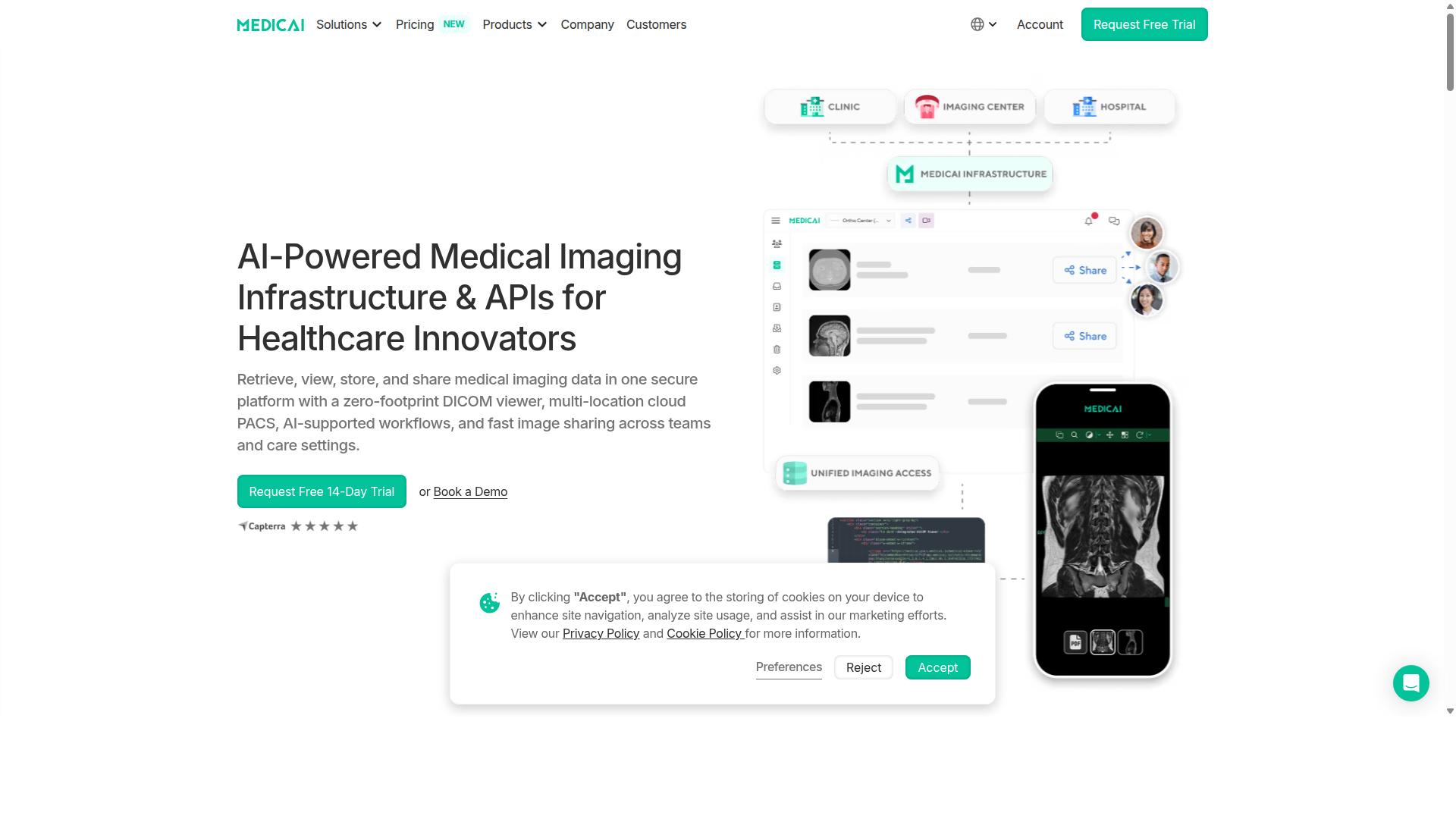
Medicai is a zero-footprint, cloud-based medical imaging platform that retrieves, stores, and shares DICOM studies across care networks. The system combines multiple components that work together to support modern radiology workflows and enterprise imaging needs.
Cloud PACS forms the foundation for image viewing and access. Vendor Neutral Archive provides long-term storage that avoids vendor lock-in and supports data ownership across different healthcare IT environments.
Medical Image Exchange enables secure sharing between teams and care settings. Patient Case Management keeps imaging data organized with patient records for quick retrieval during clinical review.
DICOM Gateway connects on-premise systems with the cloud platform. This integration supports interoperability through standard protocols and helps facilities transition from legacy PACS to modern cloud storage solutions.
Research suggests cloud-based VNAs reduce infrastructure costs while maintaining HIPAA compliance and GDPR standards. Medicai processes over 1M studies annually through its Imaging Infrastructure as a Service model.
What Is Intelerad?

Intelerad provides on-premise and hybrid enterprise imaging solutions for radiology groups and hospitals. The company has maintained a long-standing presence across North American healthcare systems.
Intelerad operates as a well-established PACS and VNA provider. Their systems support DICOM workflows and medical imaging storage needs in traditional hospital environments.
Healthcare organizations have relied on Intelerad for enterprise imaging infrastructure. Their solutions address on-premise storage requirements and support radiology workflow integration.
Intelerad serves facilities that need traditional deployment models. Their platform handles image retrieval and patient records management within established healthcare IT environments.
Features Compared
Three core areas differentiate the two platforms: archive architecture, multi-site access, and security posture.
Each platform approaches these areas differently, creating distinct operational profiles for healthcare organizations. Understanding these differences helps facilities choose systems that match their specific infrastructure and compliance requirements.
Cloud PACS and Vendor-Neutral Archive Architecture
Medicai hosts a fully cloud-native VNA on Microsoft Azure and Amazon AWS with automatic scaling and 99.99 % uptime SLA.
The system offers flexible storage tiers, including 500 GB Starter and 2 TB Standard plans, allowing organizations to match capacity with actual usage. Automatic scaling handles variable imaging volumes without manual intervention.
Built-in backup and disaster recovery capabilities protect data against local failures and regional outages. Cross-region replication maintains availability even during major infrastructure disruptions.
Intelerad operates as a traditional on-premise or hybrid VNA, requiring local hardware management and periodic capacity planning. This approach gives facilities direct control over physical infrastructure but creates ongoing maintenance responsibilities.
Organizations with limited IT resources often prefer cloud-native solutions that shift infrastructure management to the vendor. On-premise systems demand dedicated technical staff and regular hardware refresh cycles.
Multi-Location Data Access and Sharing
Medicai supports both web-based and mobile DICOM viewers with 300k+ visualizations last year, enabling instant image exchange across facilities.
The Medical Image Exchange feature allows radiologists and referring physicians to access studies from any location without specialized software. Patient Case Management tools organize imaging data with relevant clinical information for efficient review.
A zero-footprint viewer eliminates installation requirements, enabling remote radiologists to interpret studies from various devices. The system also supports teleradiology workflows for facilities with distributed reading networks.
Intelerad provides multi-site capabilities through its enterprise imaging platform, though specific access methods and deployment models vary by implementation. Organizations typically require additional configuration for cross-facility workflows.
Facilities with frequent image sharing needs between locations benefit from platforms designed specifically for medical image exchange. Traditional systems may need separate solutions for external physician access and patient portals.
Compliance and Security Standards
Medicai is both HIPAA and GDPR compliant with encryption at rest and in transit plus granular role-based access controls.
The platform follows OWASP security guidelines and maintains FDA/CEE cleared viewers for clinical use. These certifications address data protection requirements for healthcare organizations operating across multiple regulatory frameworks.
Granular access controls allow administrators to define permissions based on user roles, facility locations, and study types. Audit logging tracks all data access and modifications for compliance reporting.
Intelerad functions as an enterprise-grade platform that also meets major healthcare compliance standards. Specific certification details and implementation approaches depend on individual customer deployments and configurations.
Healthcare organizations must verify that any chosen platform maintains current certifications relevant to their geographic operations and patient populations. Compliance requirements continue evolving as privacy regulations expand globally.
Pricing Compared
Medicai's transparent monthly plans start at $249 for 500 GB and $749 for 2 TB with unlimited user accounts. These tiers make budget planning straightforward for teams evaluating vendor-neutral archive solutions. Organizations avoid surprise fees that often appear with enterprise licensing models.
Intelerad typically offers enterprise licensing without publicly listed tiers or fixed storage amounts. This approach suits large hospital systems but leaves smaller practices guessing about final costs. Many radiology groups prefer seeing exact numbers before committing to any medical imaging platform.
Medicai's Starter plan gives 500 GB cloud storage and unlimited accounts for $249 monthly. The Standard plan expands to 2 TB storage while maintaining unlimited users for $749 monthly. Both options include a free 14-day trial with no credit card required.
Yearly billing provides 15 percent savings. The Starter plan drops to $209 monthly when paid annually, while Standard costs $639 per month on yearly terms. This structure helps practices manage cash flow while accessing full vendor-neutral archive capabilities.
Connection limits differ between tiers. The Starter plan supports no connected locations, while Standard includes one location. Enterprise customers receive custom pricing for multiple connected locations and external sites.
One-time setup costs apply to DICOM Gateway installation. Each location requires a $1,000 fee regardless of chosen tier. Per-study pricing remains available for larger enterprise deployments that need flexible billing arrangements.
Intelerad's enterprise approach often involves longer contract negotiations and custom quotes. This process can extend implementation timelines for vendor-neutral archive projects. Medicai's clear pricing reduces these delays while maintaining full medical imaging interoperability features.
Who Should Choose Medicai
Hospitals, imaging centers, and specialty groups (orthopedics, oncology, cardiology, etc.) managing multiple locations benefit from Medicai's cloud VNA.
Single-site clinics commonly select the Starter tier because it matches their limited storage needs and straightforward imaging requirements.
Multi-site networks turn to the Standard tier for its expanded capacity and distributed image routing capabilities.
API integration allows these organizations to connect their existing PACS and RIS systems without major infrastructure changes.
The zero-footprint viewer enables radiologists and referring physicians to access studies from any workstation or device across their network.
Distributed radiology teams rely on this combination of cloud storage and cross-platform access to maintain consistent workflow regardless of location.
Specialty care providers in orthopedics, neurology, oncology, cardiology, and similar fields find the platform particularly suited to their image sharing needs across multiple departments.
Virtual care providers and teleradiology services also benefit from the interoperability features that support both HL7 and FHIR standards.
Who Should Choose Intelerad
Large health systems with strict data-residency policies or legacy on-premise infrastructure may prefer Intelerad. These organizations often maintain existing capital investments in local hardware and require extensive customization of their archive environment. Vendor-neutral archive solutions can operate in both cloud and on-premise configurations.
Health systems that handle complex multi-site deployments frequently need fine-grained control over storage locations and network configurations. Intelerad supports environments where data security policies mandate complete physical control of medical imaging assets. Organizations with established IT teams can manage the ongoing maintenance requirements that accompany on-premise solutions.
Institutions that prioritize deep integration with existing PACS and radiology workflow systems may find value in Intelerad's customization capabilities. HL7 and FHIR compatibility allows for tailored connections between disparate systems. These organizations often manage their own disaster recovery protocols and maintain dedicated infrastructure staff.
Facilities that process high volumes of DICOM studies across multiple departments might appreciate the ability to configure routing rules specific to their internal processes. Image retrieval performance can be optimized for local network conditions. Organizations that value complete control over their enterprise imaging environment may find this approach beneficial.
Final Verdict
For teams prioritizing rapid cloud deployment, transparent pricing, and API-first extensibility, Medicai is the stronger option.
Key differentiators include cloud-native VNA architecture that eliminates on-premise hardware requirements. This approach supports global availability across multiple healthcare systems without infrastructure overhead.
Medicai handles 50M+ API transactions per year, which enables seamless interoperability with existing PACS and radiology workflow systems. The platform also stores 1.7M+ studies, demonstrating proven capacity for enterprise imaging environments.
These capabilities address common pain points in medical imaging management. Organizations seeking alternatives to traditional vendor-neutral archive solutions benefit from reduced vendor lock-in and improved data ownership.
Intelerad solutions typically require more complex deployment timelines and may involve higher long-term storage costs. Medicai offers clearer pricing models that scale with usage rather than fixed infrastructure commitments.
Teams evaluating vendor-neutral archive options should contact Medicai for a tailored demo and migration assessment. This evaluation helps determine specific requirements for DICOM handling, HL7 integration, and cross-platform access needs.
Medicai USA is located at 7901 4th St N, STE 300, St. Petersburg, FL, 33702 and can be reached at +1 (832) 220 1035. Medicai Romania operates from 53-55 N Filipescu, 5th Floor, Sector 2, Bucharest, 020961 with phone +40 316 305 875.
Recommended Resources: